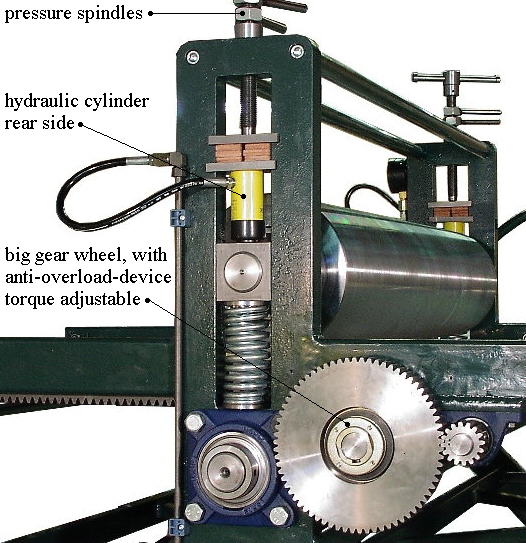
The anti-overload-coupling
is designed as a safety device
If the drive system (electric or manual) is in motion, there
is much "momentum" in the system (kynetic energy). If , for
one reason or another, the press bed blocks, all this energy
is suddenly released, resulting in damage to the rollers
and/or the mechanical drive system. To avoid this from
happening, the anti-overload-device is built in.
One can find this device built in the main gear wheel. If
the steel cover is taken off, the wheel and the
anti-overload-device are clearly visible. The device is
actually nothing more or less than a friction coupling; and
consists of disks of a fiberlike material and steel
disks.
By raising the pressure on these disks the torque that this
device can transfer is raised. For this purpose, the outher
ring (visible on the image above) is fitted with four
hexagon screws. By tightening these screws the pressure
between the disks is raised and so is the torque.
The printer will have to adjust this coupling in relation to
the torque he needs to work properly. A bigger print
requires a different setting then a small print. It is
important to set this correctly. If one sets is only for
correct work with big prints, it might lead to damage if
this setting is not adapted when printing small prints, and
a sudden blocking occurs.
Use the
"back-button" to go back to the
JZM-series.
|