|
AKUA-KOLOR
WATER-BASED INK
Instructions
|

|
Preparation
Before beginning, add a
flip top lid and shake all colors for one minute. In the
case of bottles containing a mixing ball, the mixing time
begins after the ball rattles.Cleaning the plate with soap
and water or cleanser before using will prevent Akua Kolor
from beading up on the plate.
Selecting
Monotype Plates
Use thin 2mm (1/16")
polycarbonate plastic plates. Thicker plates will cause dry
paper to wrinkle with press pressure. Akua-Kolor can also be
applied to frosted mylar or acetate to add color shapes or
stencils.
Selecting
Monotype Papers
Akua-Kolor printed on
dry paper gives back much more intense colors, while
dampening the paper results in soft colors and possibly soft
edges from the inks bleeding into the damp paper. Dry paper
also allows for easy registration as the paper will not
shrink or expand. Smooth paper works best for monotypes.
Textured papers will cause the print to look grainy. For
best results use:
- Hahnemuhle Monotype or
Hahnemuhle Silkscreen (Other Hahnemuhle papers are not
recommended.)
- Rives BFK
- Lana Gravure
- Magnani
Pescia
- Arches 88 (Other Arches
papers are not recommended)
Rolling-Up
Akua Kolor
The instructions below
apply to rolling up the monotype plate with Akua Kolor and
printing with a press using dry printmaking papers.
|
|

|
|
Adding
drops of Akua Kolor to the monotype
plate.
Photo from SAFERPRINTMAKING
video.
|
|
|
|
|
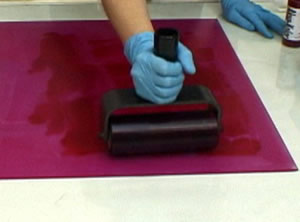
Rolling up
Akua Kolor on the monotype plate.
Photo from SAFERPRINTMAKING
video.
|
|
|
STEPS
- Add a few drops
of ink to the printing plate. Small size plates:
about 2–3 drops. Medium size plates about
5-10 drops. Large size plates: about 10-20 drops
- Add 2 to 3
drops of Retarder into the ink. Mix the ink and
Retarder with the edge of the brayer
- Roll out the
ink evenly over the entire plate using a soft
rubber brayer.
- Add a few more
drops of ink and roll out again. Do not add more
Retarder. The ink should be very thin on the
plate.
- Wait three
minutes. Waiting allows the ink to thicken so
additional layers will adhere.
- Add a few more
drops of ink and roll out. Increase the amount
of ink by a few drops for each roll up. If the
brayer starts to slide, wait another three
minutes before continuing.
- Lift the plate
and look through it to see how dense the color
looks.
- Continue adding
drops of ink and rolling until the desired
density is reached.
- The number of
layers needed to reach a solid, opaque color on
the plate depends on the pigment. Some pigments
cover more readily than others. Black: 8 to 10
layers for the maximum opaque black Yellow:
about three layers .Blue: about five layers
Burnt Sienna: about six layers Ultramarine and
the earth colors are the hardest to read, while
yellows and reds are the easiest.
|
TIP
After printing, if you plan to ink up the printing plate
again, it is not necessary to clean it unless you are
switching to a lighter color. In fact, the ink residue will
help build up new ink layers quickly.
|
Painting
On the Plate
Pour Akua Kolor
straight from the bottle onto a palette. Dip the
brush into the ink and apply to the plate. Clean
the brush with water. Dry excess water off the
brush before using it again. Check for puddles of
ink on the plate. If puddles are seen, blot them
with tissue paper before printing
Modifying
Akua Kolor
For fluid
brushwork and thin roll up coats, use Akua Kolor
right from the bottle with no modification. A
variety of modifiers and methods are available for
special effects and changing the consistency of the
ink.
|
|

|
|
William
Jung paints on the monotype plate with
Akua Kolor
Photo from SAFERPRINTMAKING
video.
|
|
Retarder
To prevent the ink from
drying on the plate, add Retarder to Akua Kolor. This will
also help release the ink onto dry paper during the printing
process. Only a little is needed, as too much will cause the
ink to bead. Retarder is ideal for hot, dry or very cold
environments.
Blending Medium
To create wash effects
and blends on monotype plates and paper, use Blending
Medium. Pour a small amount onto a palette and blend as
desired. Blending Medium can be use with Akua Kolor or Akua
Intaglio Inks. Use with Akua Intaglio inks to loosen the
consistency for brushwork for monotypes or to increase plate
tone for intaglio plates.
Air Thickened Akua Kolor
Akua Kolor will "air
thicken" after being left uncovered over a period of time on
a palette. Air thickened Akua Kolor will produce a heavier
brush stroke and denser roll up coat. Use a watercolor
palette with a lid and cover until desired thickness is
achieved.
|
|

|
|
"Air
Thickened" Akua Kolor
Photo from SAFERPRINTMAKING
video.
|
|
|

|
|
Tack
Thickener
Photo from SAFERPRINTMAKING
video.
|
|
Extender.
Add Extender directly to
the colors on the palette that have become too thick.
Extender will re-constitute air stiffened ink. With Extender
the ink will again become loose enough work easily. Avoid
adding water to Akua-Kolor inks. Water will cause the inks
to dry on the monotype plate and prevent them from releasing
onto dry paper.
Tack Thickener
To thicken Akua Kolor
and achieve semi-gloss color, add Tack Thickener. With Tack
Thickener Akua Kolor feels more like oil based ink.Tack
Thickener also keeps the ink on the surface of the paper so
that it remains vibrant after it dries (haziness upon drying
indicates the ink has soaked into the paper. Slowly pour
Akua Kolor into the Tack Thickener. It is always easier to
mix a thinner ingredient into a thicker ingredient. Add
small amounts of Tack Thickener and mix with a palette knife
until the desired thickness is achieved. Try adding 20% to
40% Tack Thickener to ink. At 50% (1 part ink to 1 part Tack
Thickener), the ink becomes grainy. This grainy texture can
easily be smoothed out by adding a few drops of Blending
Medium.
Roll out the thickened ink with a soft rubber brayer on a
seperate ink slab.. Once the brayer is evenly coated, roll
and transfer the ink onto the monotype plate.
When drawing into the inked surface of the plate, keep in
mind that Tack Thickener makes the ink wipe away with less
tonal variations. So add Tack Thickener to Akua Kolor only
if you want clean sharp lines when doing reductive
monotypes. For reductive monotypes with plenty of tonal
values use Akua Kolor alone.
Akua Oil Converter
Akua Oil Converter can
be used with both Akua Kolor or Akua Intaglio inks.
|
For Akua Kolor:
Use to produce a semi-gloss finish to the Akua
Kolor monotype. Simply roll a coat of Akua Oil
Converter onto a monotype plate and then print it
over a dry print.
|
For Akua
Intaglio:
Add directly to Akua Intaglio Inks to stiffen the
consistency if necessary. Work the Oil Converter
with the ink knife till it’s smooth before
adding into the ink. A drop of Blending Medium
added to Akua Oil Converter may help loosen the
consistency if it is too stiff.
|
Transparent Base
Transparent Base can be
mixed with both Akua Kolor or Akua Intaglio inks. Use for
creating transparent roll ups or intaglio prints. Add as
much or as little as you like.
Viscosity
Monotypes
A viscosity monotype
deals with two inks of different viscosity, thick and thin,
resisting one another. First paint thin Akua Kolor onto the
plate. Then roll thicker Akua Intaglio ink over the painted
surface. The Akua Kolor will resist the Akua Intaglio. Add
Akua Oil Converter to Akua Intaglio ink to maintain the
stiff quality if necessary.
Try using Retarder, Blending Medium or Akua Kolor Extender
for a clear resist. Tack Thickener can also be used in
varying amounts for viscosity printing.
Using
Needle Applicators
Fill the Bellows-bottles
with Akua Kolor and assemble. Press the bottom of the bottle
very gently. It will be ready to use when the color flows to
the tip. When the needle is first placed on the plate, a
small bead of ink may run off the tip. Before placing the
tip on the plate, wipe the bead of ink off by running the
tip over a piece of paper. To clean the needle tips, fill a
clean Bellows-bottle with water and squeeze the water
through the tip.
Using
Akua Kolor Pens
Akua Kolor Pens have a
unique valve dispensing system that allows the user to apply
a thin coat of ink on plastic or paper. This system helps
prevent puddles of ink on plates and increases the drying
time onto paper. Fill the pens with Akua Kolor, and depress
the tip with a gentle pumping action. It will be ready to
use when color flows to the tip. To clean the pen tips,
remove them from the pen and wash under running
water.
Hand
Printing
The use of an etching
press may not be necessary when printing monotypes,
especially with Akua water-based inks. A baren, wooden
spoon, bone file, or kitchen roller may offer good results
for small plates but may cause uneven impressions for larger
plates. The PinPress, was made specifically for printmakers.
It is a machined aluminum roller that insures precision
printing for large and small plates.
Hand printing requires a different approach than when
printing with a press. Therefore, it is important to follow
the instructions below when printing without a press.
|
Developing the
Monotype Image for Hand Printing
Develop your image
on a thin, smooth plastic plate, Just about any
smooth, non-porous surface will work— frosted
mylar, acetate, or butcher paper. Thinner plates
are easier to roll onto with the PinPress
--1/16” polycarbonate plastic is ideal.
Sand or scrape off any burr the plate has around
the edges (a burr or raised edge won’t allow
the roller to apply pressure to the plate
surface—suspect a burr if you see a halo
around the edge).
Rolling up the ink
for Hand Printing
For best hand print
results use thick ink. Akua Intaglio ink can be
used right from the jar or Akua Kolor can be made
thicker with the addition of Transparent Base or
Tack Thickener.
- Akua Intaglio
inks offer greater color density and prints well
by hand.
- Akua Kolor with
the addition of Transparent Base or Tack
Thickener will release from the plate with the
very lightest of pressure. Akua Kolor without
modification is too thin to print by hand.
Unmodified Akua Kolor only transfers well with
the pressure of an etching press.
|
|

|
|
Hand
Printing with The PinPress
|
|
Brushwork for Hand Printing
Akua Kolor or Akua Intaglio
inks may be used for brushwork. Both inks may need some
modification.
- If Akua Intaglio ink is
too thick to brush, loosen it by adding a few drops of
Akua Kolor Blending Medium. Then paint your image
directly onto the surface of a clean plate.
- When using fluid Akua
Kolor for brushwork for hand printing it will be
necessary to coat the plate with Akua Intaglio
Transparent Base first. Roll a thin coat of Akua Intaglio
Transparent Base onto the monotype plate; then paint with
Akua Kolor ink.
- A drop or two of Akua
Kolor ink can be added to the Transparent Base before
rolling it up to create a different plate tone background
color to work on.
Selecting Papers for Hand
Printing
Print to a super smooth
surfaced DRY PAPER such as Arches 88 silkscreen. Other
papers may need to be slightly damp for a good release when
printing by hand.
Press beds for Printing
with the PinPress
Most table tops, laminated
surfaces, and Plexiglas are not’t as flat as they
appear. You can easily check a surface by rolling a PinPress
across it. Any gaps that appear between the roller and the
surface indicates an uneven surface these areas will not
receive pressure during printing.
- We recommend 1/4”
or thicker tempered plate glass.If you have a heavy glass
table top, you’re set. Otherwise, you can order
tempered plate glass from a glass retail outfit. In any
case, you need a truly flat surface for successful
printing.
- For optimum leverage,
have the surface used as a press bed slightly lower than
hip level.
Registration
- For quick and easy
registration, place a piece of paper the same size as
that you are going to print to under the glass press bed.
Simply center your plate over it. Then as you drop your
printmaking paper over your plate, line it up with the
paper under the glass.
- Add a little water
between the surface of the glass press bed and printing
plate. The water will suck the plate down and prevent the
plate from moving.
Using the Pin
Press
- Place the printing plate
on a super level surface
- Lay your printmaking
paper on top of the plate. If you are using moistened
paper, cover with an absorbent blotter (Viva brand paper
towels are great blotters for small plates). Add a soft
felt blanket for printing intaglio plates or adding chine
collé.
- Apply pressure by
rolling completely across the plate, being careful not to
cut across the plate with the edge of the roller. Lift a
corner of the paper to check the transfer—keeping
one hand lightly pressing the other half of the paper to
the plate to keep the paper/plate
registration.
- Apply additional
pressure with the roller as needed. Rolling up and down,
then side to side, will enhance the plate mark. Lift and
check a corner again before pulling paper from plate.
Cleaning
up
Most of the time Akua
Kolor, Retarder, Extender, and Blending Medium will clean up
easily with just a damp rag.To clean color stained plastic
surfaces use liquid dish detergent mixed with water or a non
abrasive cleanser such as Bon Ami.
Clean up Akua Intaglio inks, Akua Oil Converter, Transparent
Base and Tack Thickener with liquid dish detergent mixed
with water. (About 1 part liquid dish detergent to 20 parts
water). Before applying water, remove as much ink or
modifier as you can with a dry rag. A textured cloth works
best.
Trouble
Shooting
|
Dry Paper wrinkles
when going through the press
- Use a thinner
monotype plate
Akua Kolor is
not releasing from plate to dry
paper
- Apply more
pressure
- Try different
papers
- Add Retarder to
the ink
Akua Kolor
rolled on to the plate feels too
stiff
Colors on
finished prints dry hazy.
Haziness upon
drying indicates the ink has soaked into the paper
hazy
- Try a less
absorbent paper.
- Add Tack
Thickener to the ink
- Add less
Retarder, Blending Medium, or Extender
Akua Kolor
beads-up on plate
Akua Kolor may
bead up on the plate if the surface is not clean or
if too much Retarder, Blending Medium or Extender
is added.
- Clean plate
with soapy water before applying
- Add less
Retarder or Extender to the ink
- Add a drop of
liquid dish detergent to ink
- Apply a thin
coat of liquid dish detergent to brush and paint
over the beaded area
Rubber Brayer is
sliding when rolling-up Akua Kolor
- Follow steps
for Rolling up Akua Kolor above
|
Akua Kolor is
too thin when doing a roll up
- Thicken with
Tack Thickener or Air Thicken
- Use a Foam
Brayer
- Try Akua
Intaglio water-based ink
Akua Kolor is too
transparent
- Select color
with intense transparency rating
- Add white
- Add Tack
Thickener
- Air Thicken
- Use Akua
Intaglio Inks
Akua Kolor is
too thin for brushingl
- Allow Akua
Kolor to sit on an uncovered palette till it
thickens
Puddling of ink
occurs with Needle Applicator
- Wipe the bead
of ink off by running the tip over a piece of
paper before placing on the plate
- Use a plate
with a dull surface opposed to slick
- Flip the needle
to the opposite direction while
drawing
- Mix a small
amount of Tack Thickener to the ink before
filling the bottle
Print needs to
be dampened for final intaglio plate
- Spray the back
of the print with water
|
Woodcuts
/ Linocuts
|
Western Roll-up
Method
Use Akua Intaglio
Inks or add Akua Kolor to Akua Intaglio Transparent
Base.
Traditional
Japanese Hanga Method
When doing the
Japanese technique, use Akua Kolor like watercolor
and mix it on the wood block with water and a
little wheat paste or methylcellulose. The amount
of each depends on the color you want, the moisture
already in the paper and on the brush, and the
humidity. Brush it out with a stiff horsehair brush
and lay paper on top, then rub the back of the
paper with a baren. It takes some practice to get
the balance of moisture right so the color goes
cleanly into the paper. Note: The addition of wheat
paste or methylcellulose on the block is optional.
|
|

|
|
April
Vollmer printing a Japanese Hanga
Woodblock.
Photo from SAFERPRINTMAKING
video.
|
|
Creating
directly on Paper
We recommend using the
Akua-Kolor Pens for creating directly on paper. The
Akua-Kolor Pen has a unique valve dispensing system that
allows the user to apply a thin coat of ink that will dry on
the paper within hours. Heavier brushstrokes on paper may
take several weeks to dry. Drying time may also depend upon
humidity conditions.
Use the
"back button" to go to the previous
page.
|