!


|
|
|
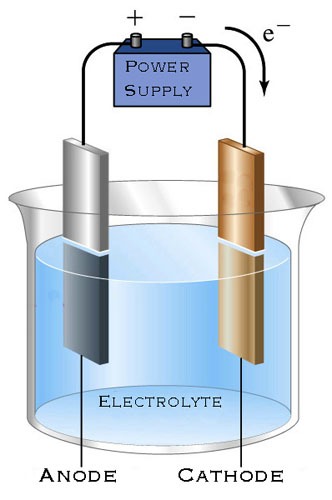
If you place two plates of the same metal in parallel - with no contact between them - into a solution made from a salt of the same metal and water to give a conducting liquid, then connect the plates to terminals of a direct current power supply or battery, the current will flow from one plate to the other through the solution (the electrolyte). The electrolyte contains positive metal ions and negative sulfate ions. When the current flows, positive and negative ions of the electrolyte are attracted to the plate of opposite polarity. Positive metal ions are adhered or "attached" to the cathode (negative pole) and the negative sulfate ions are attracted to the bare areas of the anode (positive pole) and react with the metal surface oxidizing and eroding it*. The result of this process is a bite in the metal that is comparable with an acid etching; but with some very useful differences! The plate you wish to etch is attached to the anode (+) and placed in the tank facing (in parallel with) another plate that is attached to the cathode (-), with a distance of 6 to 10 centimeters between them The amount of sulfate in the solution does not change, and the electrolytic bath is reusable. The solution is not depleted with use. This balance and stability in the solution allows you to calculate bite-times more accurately than with acids. This process does not release toxic gases such as those produced by etching zinc, copper and iron plates with nitric or hydrochloric acid. And, by taking some minor precautions when you introduce and remove plates from tanks or during the washing process for example, you can consider it a fairly harmless technique. Electrolytic processes, using electricity, have the advantage of not producing waste, such as gas bubbles which with traditional acid etching can block the bite, nor does it produce sediment that can builds up on the plate and at the bottom of a tank as with other methods. |
|
This system of electrolytic etching has been around since the 19th century and has been used in many technical sectors. For several decades now, it has also been used by printmakers. A number of people in the graphic arts sector have contributed to this. Some of them are mentioned here, including links to their websites: |
|
|
|
|
See below |